I guess that depends a lot on the installation, as well as whether the reduction drive is well matched to the prop requirement and motor characteristics.
This motor is capable of running at 125A phase current, with a claimed 92% efficiency between 24 and 96V. Running at 125A at 48V, for example, would mean that the motor is absorbing around 480 watts and turning it into heat (although I strongly suspect that the true figure would be much higher than this at 125A, as I don't believe the 92% efficiency figure is even close to being correct for this high a current).
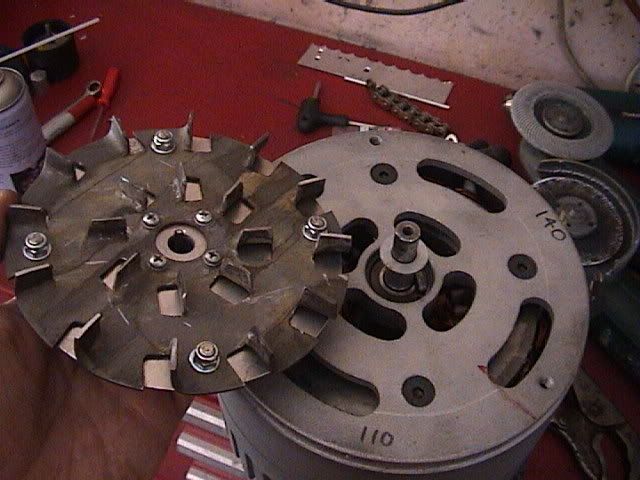
The stock cooling system in this motor isn't great, just an extremely crude pressed metal fan at the non-drive end, under the plastic cover (here's a photo of it: http://i37.photobucket.com/albums/e62/ripperton_2008/Electric%20R1/FAN2.jpg?t=1299793812).
It wouldn't be hard to make a far more effective cooling system than this, although that does mean altering the way the Hall sensor magnet mounts (at present it is bolted to the back of the cooling fan).
Running the motor at a higher voltage (and hence rpm) and lower current, with a higher ratio reduction drive, would help a lot, probably more than adding a cooling system, as the motor efficiency would be significantly better at the lower current.
Jeremy
--- In electricboats@yahoogroups.com, "Andrew Gilchrist" <andrew@...> wrote:
>
> A 30C drop shows the cooling is efficient - but what does that 30C of heat
> say about efficiency of the controller motor prop setup?
>
>
>
> Andrew Gilchrist
>
> www.fastelectrics.com
>
> 612 4982 5481
>
> Australia
>
> _____
>
> From: electricboats@yahoogroups.com [mailto:electricboats@yahoogroups.com]
> On Behalf Of Eric
> Sent: Sunday, 11 September 2011 1:55 AM
> To: electricboats@yahoogroups.com
> Subject: [Electric Boats] Re: belt drives vs directly coupled motor shafts
> and torque
>
>
>
>
>
> So that means that when James observed a 30C reduction in heat readings from
> the sensor using his water plate/air fan cooling setup for the same power
> and load, the system is resonably effective. Since the temp sensor is at the
> hottest location that is the toughest to cool, temp drops there actually
> mean something.
>
> Fair winds,
> Eric
> Marina del Rey, CA
>
> --- In electricboats@yahoogroups.com
> <mailto:electricboats%40yahoogroups.com> , "Jeremy" <jeremy_harris_uk@>
> wrote:
> >
> > It's tucked into the non-drive side stator windings, Eric, which should be
> the hottest part, as the thermal path from there is poorer than for the
> stator on the drive shaft end.
> >
> > Jeremy
> >
> > --- In electricboats@yahoogroups.com
> <mailto:electricboats%40yahoogroups.com> , "Eric" <ewdysar@> wrote:
> > >
> > > Hi Jeremy,
> > >
> > > Hmmm, that makes me wonder where the factory installed temp sensor is
> specifically located... But for me, it's only curiosity. My motor gets
> nowhere close to overheating.
> > >
> > > Eric
> > >
> >
>


No comments:
Post a Comment